
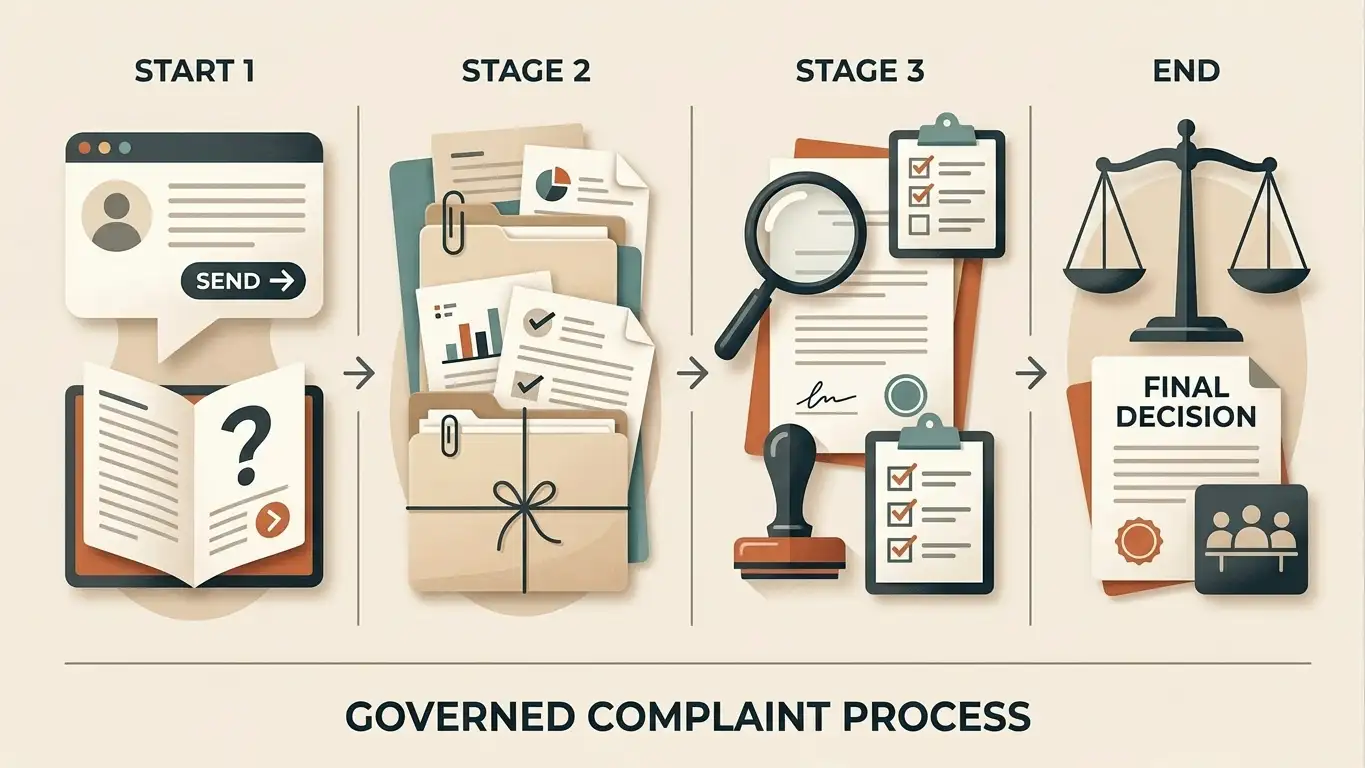
If you have a LottoGo complaint, start with LottoGo and keep a complete record of the issue. Current UK Gambling Commission guidance says customers must first go through the gambling business’s own complaints procedure. The operator has up to eight weeks to resolve the complaint, although the process can end sooner if it reaches a final position or deadlock. If an eligible dispute remains unresolved, it can then move to the operator-designated Alternative Dispute Resolution provider. The ADR service is independent and free to the customer. The Gambling Commission regulates the licensed business but does not act as the decision-maker for an individual transactional dispute. LottoGo provides live-chat support and the support email address [email protected], giving you two practical starting channels. Keep dates, amounts, relevant transaction details, messages and written responses together from the first contact.
LottoGo Dispute Escalation: Step-by-Step Complaint Resolution
LottoGo provides live-chat support and the email address [email protected]. For a complaint, the goal of the first contact is not simply to ask whether someone can “look into it”. State that you are raising a complaint, identify the account or transaction involved, describe the outcome you believe is wrong and explain what resolution you are asking for.
If you begin in live chat, save or export the transcript if the interface allows it. If the matter is complex, a written email can make the chronology easier to preserve. Whatever channel you use, keep your wording factual. Separate what happened from what you think caused it, and avoid making your own complaint harder to follow with several unrelated issues in one message.
If you are still deciding whether the brand itself is properly licensed, the LottoGo UKGC licence and trust checks page covers the operator and regulator record. That is a different question from whether a particular complaint should be upheld.
Complaint records
Keep a clear LottoGo complaint record
The UKGC tells customers to give the gambling business the relevant dates, times and amounts and to keep copies of what they send. A clear record helps keep the dispute focused on the transaction or account action at issue.
Records to keep
- The date and approximate time the issue occurred.
- The amount involved and the relevant deposit, wager or withdrawal details.
- Transaction references, account messages or status screens that relate directly to the issue.
- Copies of emails, live-chat transcripts and operator responses.
- The exact outcome you asked LottoGo to provide.
- The date on which you first submitted the complaint, because the regulated complaint timetable runs from receipt.
Keep earlier records when the issue changes state. A withdrawal can move from pending to completed, an identity request can be updated, or support can provide a new explanation. The sequence of account messages and responses can matter later in the complaint process.
Eight-week framework
The regulated complaints process has a defined end point
The Gambling Commission requires licensed operators to have complaints procedures that are fair, open and transparent. Current guidance says the entire process must take no longer than eight weeks from when the operator first receives the complaint. The operator can reach a final position sooner, and an earlier deadlock can allow the dispute to move on before the full eight weeks have elapsed.
| Stage | What to do | What to keep |
|---|---|---|
| 1. Submit | Raise the complaint directly with LottoGo and explain the requested resolution. | Your original message and the submission date. |
| 2. Operator complaint handling | Respond to reasonable requests that are relevant to investigating the complaint. | Every reply, attachment and status update. |
| 3. Internal escalation | Follow any further internal stage LottoGo identifies if you remain dissatisfied. | The response you disagree with and why. |
| 4. Final response or eight weeks | Look for confirmation that the operator has reached its final position or that the eight-week period has ended. | The final response or deadlock communication. |
| 5. ADR | If the dispute is eligible, take it to the ADR provider LottoGo identifies for that dispute. | The complete complaint record and operator response. |
Great Britain complaints route: UK Gambling Commission complaint guidance and ADR guidance.
Independent escalation
Use the ADR provider identified for your LottoGo dispute
Alternative Dispute Resolution is the independent stage after the operator’s own process has been exhausted. UKGC guidance says the service is free for the customer and that you must first have gone through the gambling business’s complaint procedure. The operator should tell you which ADR provider applies and how to contact it.
The ADR provider should be the one LottoGo identifies for the dispute after its internal complaints process. The UKGC says the gambling business should provide the relevant ADR details and may issue a deadlock letter when the internal process has concluded.
The Gambling Commission has a different role. It sets and enforces rules for licensees and can use information about wider regulatory concerns, but it does not replace the ADR route by deciding your individual transaction dispute. That difference is important if your goal is a case-specific remedy rather than reporting a broader regulatory concern.
Before escalation
Separate a payment or verification problem from the complaint itself
If the issue concerns a cash-out, identify the status of the withdrawal and any account action requested by LottoGo. The LottoGo withdrawals page explains the operator and payment-network stages without assigning one timing promise to every transaction.
For an identity issue, use the LottoGo verification page to distinguish the baseline Great Britain age and identity requirements from any additional account request. Keep the exact request, the date it was made and the date you responded.
For a problem that began during sign-up, the LottoGo registration page separates account creation, identity checks, safer-gambling controls and funding. That can help identify which stage produced the dispute and which records belong with the complaint.
Online comments
Online comments do not replace the regulated complaint route
Public complaint forums cannot resolve an individual LottoGo transaction. Another customer’s post will not contain your full account history, the terms that applied to your transaction or LottoGo’s response to your case. Use your own records and the formal complaint route for the dispute you are raising.
For your own dispute, rely on the transaction record, your communications, the operator’s response and the formal escalation route. Another customer’s account can involve different dates, terms and account circumstances. If you want the broader product and licensing picture before deciding whether to keep using the service, the main LottoGo page covers those topics separately.
Escalation discipline
How to escalate a LottoGo complaint in Great Britain
An ADR referral is not available simply because a customer dislikes a support answer. The gambling business’s own complaint procedure comes first. After eight weeks, or when the business reaches the end of its internal process and issues the appropriate deadlock information, an eligible dispute can move to the independent ADR stage.
ADR is free to the customer. The provider considers information from both the customer and the gambling business and decides whether the dispute falls within its scope. General customer-service dissatisfaction and a business refusing to accept a bet are examples the Gambling Commission says an ADR provider might not accept, so identify the gambling transaction or regulated dispute clearly.
The Gambling Commission has a different role from ADR. It licenses and regulates gambling businesses and can receive information about wider compliance concerns, but it does not replace the operator and ADR route when the customer wants an outcome on an individual transaction.
A deadlock letter can matter before eight weeks have passed. If LottoGo says its internal complaint procedure is complete and provides the applicable ADR details, keep that final response with the original complaint, transaction records and subsequent correspondence. The ADR provider can then see both the issue raised and the position LottoGo reached internally.
When the dispute involves a withdrawal, bonus or identity request, keep the terms or account message that applied to that specific event. A complaint is easier to follow when the amount, date, status and requested resolution are tied to one clear chronology rather than mixed with unrelated account questions.
The eight-week period runs from the gambling business receiving the complaint, not from the date of the original wager or transaction. Keep the complaint submission date separately from the date on which the underlying issue occurred. If LottoGo reaches its final position sooner, retain that response because it can establish that the internal stage has ended before the full eight weeks.
Start with LottoGo, clearly mark the issue as a complaint and keep the date, amount, transaction details and response trail. The Great Britain process gives the operator up to eight weeks to resolve the complaint. If the internal process is complete and an eligible dispute remains unresolved, the operator should identify the ADR provider that can consider it. The UKGC regulates the gambling business but does not decide the individual transaction dispute for you.
Independent information about LottoGo. Gambling is for adults aged 18+.
Material created by the team LottoGo