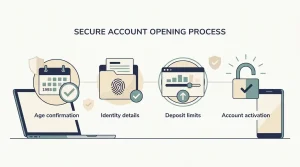

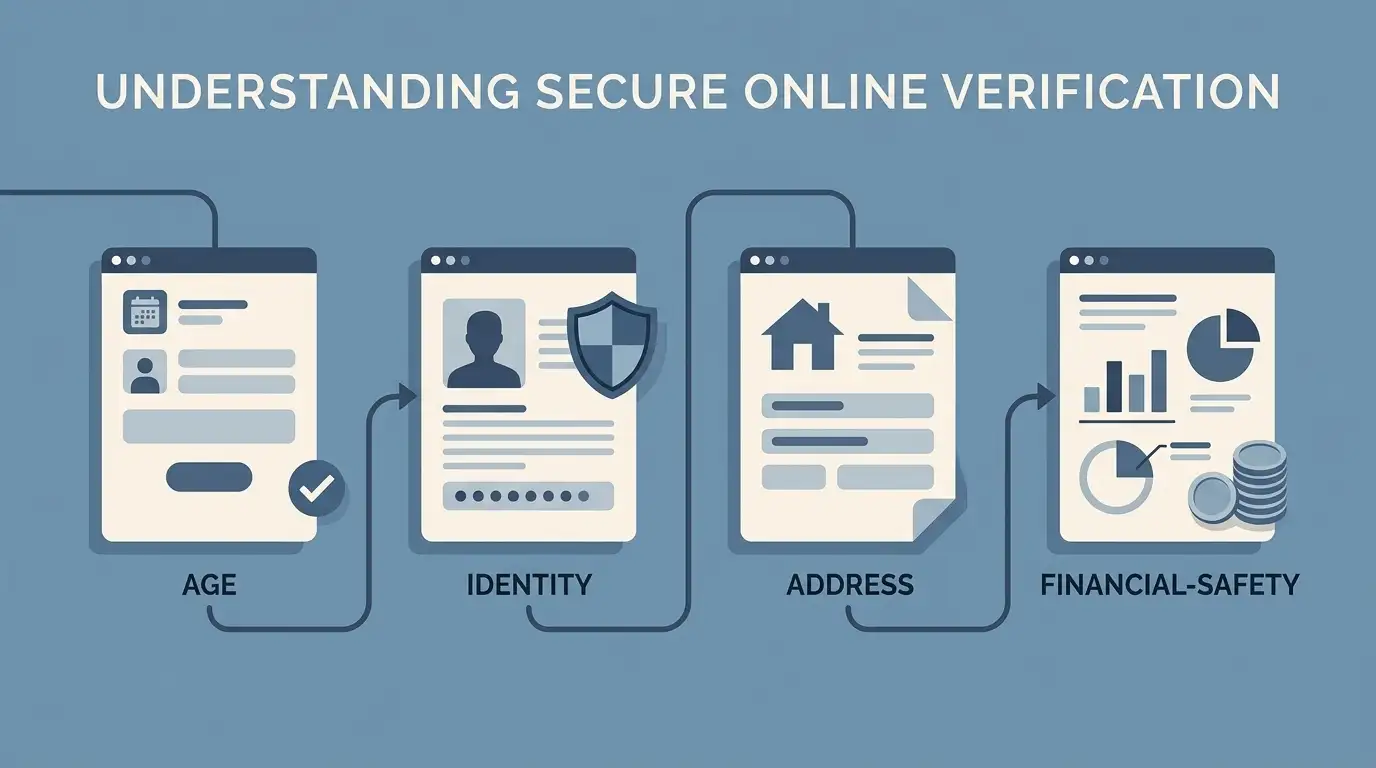
LottoGo carries out identity verification, and Great Britain rules require more than a simple age tick-box. A remote operator must establish age before allowing a customer to deposit, use free-to-play gambling games or gamble. Before gambling, it must also obtain and confirm the customer’s name, address and date of birth. Additional information can still be requested where legal or risk controls require it. The important distinction is between the baseline age and identity checks, any later account-specific request, and the separate financial-vulnerability process triggered by the applicable regulatory threshold.
Verification layers
LottoGo Verification Checks: Age, Identity and Financial Assessment
The word KYC is useful shorthand, but it can hide several distinct processes. For a LottoGo user in Great Britain, the clearest way to understand verification is to separate the mandatory age check, the baseline customer identity check and any later information request that arises because the operator has another legal or account-specific reason to ask.
| Layer | What is established | What this means for a LottoGo user |
|---|---|---|
| Age verification | The customer is old enough to use the regulated gambling service. | It must be completed before deposit, free-to-play gambling or real-money gambling in Great Britain. |
| Core identity verification | Name, address and date of birth are obtained and verified before gambling. | The account must match a real, identifiable customer rather than an unverified profile. |
| Further information | Additional information can be requested when another legal or account-specific obligation requires it. | The exact request is not necessarily identical for every customer, so a fixed unofficial document checklist can be misleading. |
| Financial-vulnerability check | A separate light-touch public-record check applies when the regulatory threshold is reached. | It is not the same thing as basic identity verification and is not a universal spending cap. |
A successful age check does not mean every other account check has happened, while an additional information request does not mean the original identity stage was skipped. Different checks serve different purposes and can occur at different points in the account journey.
Regulatory baseline
The GB baseline is age plus verified name, address and date of birth
The UK Gambling Commission’s remote social responsibility code requires age verification before a customer can deposit funds, use free-to-play versions of gambling games or gamble. Its customer identity condition separately requires remote licensees to obtain and verify information establishing identity before gambling, including name, address and date of birth.
LottoGo’s GB App Store listing describes identity verification as part of the service. For customers in Great Britain, age and core identity sit within a regulatory framework that applies before normal gambling access, while additional documents depend on the account circumstances and the request made through the secure LottoGo account.
If you are still at the account-opening stage, the LottoGo registration page places these checks in the wider sequence of sign-up, account controls, promotion choice and funding.
The age and identity requirements apply at different gates. Age must be confirmed before a remote customer can deposit, use free-to-play gambling games or gamble. Core identity information – including name, address and date of birth – must be obtained and confirmed before gambling. That means a customer should expect account checks before normal real-money play rather than treating them only as a withdrawal-stage task.
Great Britain age and identity requirements: UK Gambling Commission remote age-verification code and customer identity condition.
Document requests
Do not treat an unofficial LottoGo document list as universal
The regulator says operators should tell customers before deposit what types of identity documents or other information they can need, the circumstances in which that information can be required and how it should be supplied. That is a process requirement, not a universal list of documents that every operator must request from every customer.
For LottoGo customers, identity verification is part of the account journey. Exact document requests can differ, so the secure request shown in the official account should determine what is supplied. Avoid sending identity documents through unofficial channels or using a document list copied from another customer’s experience.
Different customers can receive different information requests. A baseline identity match can be straightforward, while another account can need further information because the operator has an additional legal obligation or needs to resolve an inconsistency. The exact request should be followed through the secure LottoGo account channel rather than assumed in advance.
Before sending anything, read the request carefully and check that the account details you entered still match your current information. Use the secure account route named by LottoGo, keep a record of what you supplied and avoid sending extra documents that were not requested. That gives you a clearer trail if you later need to ask support why a check remains open or what action is still required.
Withdrawal readiness
Verification should not be saved as an avoidable surprise at cash-out
UKGC Licence Condition 17.1.1 says a withdrawal request must not create a requirement for additional information as a condition of withdrawal when the operator could reasonably have requested that information earlier. The same rule still allows an operator to seek information that it is legally required to obtain at that later point.
For a LottoGo customer, the useful preparation is simple: keep account details accurate, respond to legitimate verification requests through the official account channel and avoid assuming that a withdrawal itself proves all checks are complete. The separate LottoGo cash-out guide explains the withdrawal process without publishing unsupported exact verification times, payment limits or fees.
If a verification issue becomes a dispute, keep copies of messages and the information you submitted. Use LottoGo’s own complaint process first and document dates and responses. The LottoGo complaints guide explains the escalation route for an unresolved complaint without treating individual online complaints as proof of wrongdoing.
Separate financial check
The £150 vulnerability threshold is not the same as identity verification
Current Great Britain remote rules include a financial-vulnerability check when a customer’s deposits minus withdrawals exceed £150 in a rolling 30-day period. The check uses customer-specific public-record information for significant indicators of financial vulnerability. The operator must consider the result together with other information it is permitted to use and take proportionate action when risk is identified.
This is easy to misread. The £150 figure is a trigger for a particular regulatory check, not a universal LottoGo deposit cap, not a statement that every customer is manually affordability-assessed at £150 and not part of the basic name-address-date-of-birth identity check. Treating those concepts separately prevents a routine KYC explanation from turning into a misleading affordability claim.
Financial-vulnerability rule: UK Gambling Commission condition 3.4.4.
Account protection
GAMSTOP matching is another account check with a different purpose
GAMSTOP is a multi-operator self-exclusion system rather than an identity-verification provider for the casino. When a person registered with GAMSTOP tries to create or use an account with a Great Britain-licensed online gambling company, the operator checks the supplied account details against the self-exclusion register. GAMSTOP also states that licensed online operators check existing customer accounts regularly.
The purpose is access control for self-excluded customers, not proof of address or a substitute for LottoGo’s own customer verification. That is why an account can involve both identity verification and a GAMSTOP check without the two being the same process. For the operator and licence context around these controls, use the LottoGo UKGC licence and trust guide.
GAMSTOP account matching: How GAMSTOP Online works.
First real-money use
The identity rule also affects withdrawals. A licensed operator must not make a customer provide extra information as a condition of cashing out when that information could reasonably have been requested earlier. A genuine legal or regulatory need can still lead to a later request, but a cash-out should not be used simply as the first convenient moment to ask for information that was already reasonably obtainable.
The separate financial-vulnerability check does not replace identity checks. Its threshold is based on deposits minus withdrawals over a rolling period, while identity rules concern who the customer is. A customer can therefore encounter both checks without either indicating that the other failed. Each request should be read according to the account message that triggered it.
How LottoGo verification affects your first real-money session
For a Great Britain user, the important expectation is that age and core identity checks are part of getting the account ready, not an optional task to postpone indefinitely. Keep your details accurate, follow verification requests only through official LottoGo account channels and do not rely on a copied document list that claims to fit every customer. If a later request appears, judge it by what the operator is actually asking and whether it relates to a legitimate account or legal requirement. The full LottoGo UK guide connects verification with payments, account setup, games and licensing so you can assess the service as a whole rather than treating KYC as an isolated obstacle.
Independent information about LottoGo. Gambling is for adults aged 18+.
Material created by the team LottoGo