

Explore how bonus buys affect slot play, why demo outcomes do not predict real-money results, and what to check before depositing.
Try Bonus Buy Slots in Demo Mode Before You Risk Money
A demo can give you a feel for a bonus buy slot without putting money at stake. You can try the game’s controls, see how its screens respond and find out whether the pace and presentation suit you. If a demo version offers access to the bonus feature, you can also see how that option is presented before deciding whether you want to explore it further.
Treat this as a chance to get familiar with the game, not as a rehearsal that predicts what will happen when you play for money. A demo balance is fictional: it is not a deposit, cannot be withdrawn and does not represent winnings. Demo play awards no payouts. A successful bonus round may be entertaining to watch, but it leaves you with nothing that can be cashed out.
That distinction matters because practice and evidence are not the same thing. A demo session can show you how the game behaves on screen, but it cannot establish that you will get similar results with real stakes. Nor can a run of favourable demo outcomes show that a slot is likely to pay you next time. Outcomes vary, and a short sequence is not a reliable guide to future results.
When choosing a site for bonus buy slots, you should check practical details as well as the games available. This list gives you the stated payout timeframe for each operator.
1. NightLuck
Payout speed: 1-3 business days NightLuck lists payouts at 1–3 business days. You can use that timeframe as one practical detail when considering it.
2. Dieselwin
Payout speed: 1-3 business days Dieselwin lists a payout speed of 1–3 business days. You can factor that stated timeframe into your choice.
3. SlotoSport
Payout speed: 1-3 business days SlotoSport gives a payout timeframe of 1–3 business days. That is the available practical detail to consider when assessing it.
4. Britsino
Payout speed: 1-3 business days Britsino lists payouts at 1–3 business days. You can keep this stated timeframe in mind when choosing a site.
5. WinBeast
Payout speed: 1-3 business days WinBeast states a payout speed of 1–3 business days. This gives you a clear timeframe to consider.
6. NightWin
Payout speed: 1-3 business days NightWin lists a payout timeframe of 1–3 business days. You can use this information as part of your assessment.
7. BeOnBet
Payout speed: 1-3 business days BeOnBet gives a payout speed of 1–3 business days. You can factor this stated timeframe into your decision.
8. Revery Play
Payout speed: 1-3 business days Revery Play lists payouts at 1–3 business days. This is the available timeframe to consider when assessing the operator.
9. Jetsetspins
Payout speed: 1-3 business days Jetsetspins states that payouts take 1–3 business days. You can keep this practical detail in mind.
10. Amunbet
Payout speed: 1-3 business days Amunbet lists a payout speed of 1–3 business days. You can use the stated timeframe when considering the operator.
Use a demo to check practical details instead. Notice whether the instructions are clear, whether you can follow what is happening on the screen and whether the pace feels comfortable. If you are unfamiliar with the interface, the practice run can help you learn where the controls and game information are displayed. You can stop as soon as you have answered those questions; there is no need to keep playing in the hope of turning practice into a prediction.
If you are looking for bonus buy video slots, the demo label alone does not tell you everything about what is available to try. A particular version may let you explore the ordinary game but not offer the buyable feature in demo mode. Check the options shown within the game, and avoid assuming that a feature is included just because the title is described as a bonus buy slot. If the option is unavailable, the demo can still help you assess the basic interface, but it cannot show you that feature in action.
Keep a clear boundary between a fictional balance and money you would actually be prepared to lose. It can be easy to treat a large-looking demo balance as proof that repeated play is harmless or that a bonus is within easy reach. It proves neither. The figure is part of the practice environment, not a measure of your likely spending or a sign of what a real-money session would return.
Online Craps Casinos in the UK: What to Check
The same caution applies if a demo session goes badly. Losing fictional credits does not mean a real-money session is “due” a win, and a favourable run does not mean you have found a way to beat the game. Demo results are simply the outcomes shown in that practice session. They do not change the game’s underlying mathematics.
For any game with a positive house edge, the mathematical expectation is negative over enough sessions, even when losses arrive gradually rather than all at once. A demo cannot remove that expectation, and a short run of results cannot overturn it. This is why it is safer to use practice to understand the interface than to use it as evidence for a money decision.
Before leaving demo mode, decide what you learned from it: perhaps the controls were easy to follow, or the presentation was not for you. That is useful information about your experience of the game. It is not a forecast of payouts. If you cannot tell whether the demo includes the feature you wanted to inspect, treat that as an unanswered question rather than filling the gap with assumptions.
A demo is most useful when you keep its purpose modest. It lets you explore a slot without staking real money and assess whether you understand what is on screen. It does not create winnings, demonstrate a dependable strategy or promise that real-money play will follow the same pattern.
Attention: A demo balance is fictional; it cannot be withdrawn and does not represent actual winnings or a prediction of future real-money results.
Bonus Buy Casinos and the UK Licensing Checks That Matter
When you look for a casino with bonus-buy slots, you are choosing an operator as well as looking for a particular kind of game. A casino’s website may group slots, table games and live casino under separate headings. Live casino is its own part of the offering: it centres on games presented with a live dealer, rather than slot titles. Finding that category alongside slots does not tell you whether the operator is properly licensed, or whether a particular slot includes a buyable bonus.
That distinction matters because a game catalogue and the operator’s regulatory status answer different questions. A casino may show a wide range of titles, but the number of games or the presence of a bonus-buy label is not evidence that the business is authorised to serve customers in Great Britain. Licensing relates to the operator and the gambling activities it is permitted to provide; it is not a rating of a game’s appeal or a promise about your results.
What the regulator covers
The UK Gambling Commission is the regulator for commercial gambling in Great Britain. Its remit includes remote gambling offered to consumers there, even when the equipment that runs a service is located elsewhere. In other words, an operator cannot avoid the British regulatory framework simply by hosting its systems outside the country.
The Commission also regulates gambling activity across the United Kingdom, including online casinos. The legal and regulatory position is not identical across every part of the UK, so it is more accurate to describe its remote-gambling remit in terms of Great Britain when discussing services offered to consumers there. For someone comparing online casino choices in England, Scotland or Wales, the key point is that the operator’s location does not remove the requirement for the relevant British authorisation.
3-reel slots in the UK: formats and play
For commercial gambling in Great Britain, the UK Gambling Commission is the sole regulator. Its role is not limited to deciding whether a site can display slot games. The Commission’s licensing framework applies to the businesses that provide gambling and, separately, to individuals who carry out certain operating roles. This makes the licence a matter of accountability for the organisation and the people responsible for running gambling operations.
Business and personal licences
The Commission grants operating licences to businesses providing gambling services. It also grants personal licences to individuals involved in operating those services. These are different forms of authorisation: an operating licence concerns the business, while a personal licence concerns an individual in a relevant role.
That distinction is useful when a casino’s marketing focuses on its game selection. A site can promote a casino bonus buy experience, but marketing language does not establish its regulatory position. Nor does the fact that a game provider’s name appears in a lobby tell you whether the casino itself holds the required authorisation. The operator is the business offering gambling to you, and its status is the relevant starting point for understanding who is responsible for that service.
A bonus-buy casino in the UK is therefore not simply a website where you can see slots with a particular feature. It is an online gambling service whose operator must sit within the licensing framework applicable to the market it serves. The catalogue can change, and slots may appear beside live casino tables or other products, but those sections of the lobby do not replace the operator’s obligations.
In Great Britain, the UK Gambling Commission is the sole regulator for commercial gambling, overseeing both operating licenses for businesses and personal licenses for individuals.
When comparing casino sites with bonus-buy games, keep the questions separate. The game catalogue tells you what the site presents; the regulator’s framework tells you which authority oversees commercial gambling in Great Britain and how businesses and relevant individuals are licensed. That context gives you a clearer basis for assessing a casino’s status without confusing a feature label with regulatory approval.
What the Bonus Buy Feature Changes—and What It Doesn’t
A bonus buy option lets you pay for direct access to a slot’s bonus feature instead of waiting for it to appear during ordinary play. That can make the game feel more immediate: you choose when to enter the feature, rather than relying on the base game to trigger it. This is the central appeal of slots with a bonus buy feature, but it is a change to how you reach a round, not a promise about what the round will return.
The details depend on the individual game. A bonus might involve free spins, a separate feature round or another special sequence. The purchase may give access to one particular feature, while other bonuses remain available only through regular play. The game’s information panel should explain what the purchase activates and how its cost relates to the current stake. Read that information before deciding; the label “bonus buy” alone does not tell you what is included.
The choice can also alter the rhythm of play. Without a purchase option, you may spend time on ordinary spins before a bonus begins. With one, you can skip that wait and move directly to the feature. For someone interested mainly in seeing the bonus round, that direct route may seem appealing. But it also means making a larger, deliberate commitment at a single point, rather than letting the feature arrive during the usual flow of play.
Best RTP Casino Slots in the UK: What RTP Means
That difference matters when you are weighing the cost. A buy option is not simply a shortcut with no trade-off: the amount paid is part of your stake, and the feature can still produce an outcome you do not want. A dramatic animation, a series of extra spins or a large-looking multiplier can make the round feel as if a substantial result is due. They do not establish that a payout will follow. The feature is an opportunity to play a particular part of the slot, not a guaranteed return.
Buying access also does not turn a slot into a different kind of financial proposition. The purchase changes the route into the bonus; it does not remove the game’s underlying advantage or ensure a better result. If a game has a positive house edge, its mathematical expectation is negative over enough sessions. That remains true whether losses happen gradually through ordinary spins or are concentrated around bought features. A short run can go either way, but it cannot make the long-run expectation positive.
This is why a bonus buy can be easy to misread. The player has selected a feature and paid to reach it, which can create a stronger sense of control than waiting for a random trigger. Control over timing, however, is not control over the result. The feature’s outcome remains uncertain, and paying to enter it does not make wins more dependable.
Buying a bonus feature does not remove the house edge or guarantee a return; it is a paid entry into a round with an uncertain result.
Before using a buy option, pause long enough to identify exactly what you are paying for and whether that cost fits the amount you had already decided to spend. If the purchase would push you beyond that amount, the fact that it opens a bonus does not make the extra stake safer. You can also choose not to buy: the feature may be available through ordinary play, depending on the game, or you may simply move on.
The most useful way to understand bonus buy feature slots is to separate access from outcome. The purchase can shorten the route to a special round and make that part of the game easier to reach on demand. It cannot promise a win, improve the mathematical expectation of a positive-house-edge game, or make a costly result harmless. When those distinctions are clear, the feature is easier to assess for what it is: a paid way to enter a bonus, with an uncertain result.
How Slots with a Buyable Bonus Fit into a Game’s Design
A slot’s bonus round is an added part of its design, not a replacement for the reels and paytable that govern ordinary spins. The base game still has its own symbols, winning combinations and ways to award prizes. A buyable bonus sits alongside that structure, giving access to a feature round without waiting for its usual in-game trigger.
High RTP Slots in the UK: Understanding the Odds
In a five-reel slot, a bet can be applied across all five reels. The reels then determine which symbols land and whether a combination matches the game’s paytable. A bonus round may use a different set of rules: it might award extra spins, apply a multiplier or build on wins made during the feature. The exact format depends on the game, so the word “bonus” alone does not tell you what happens after it begins.
This distinction matters when you look at slots with a bonus-buy option. The ordinary game and the feature round may feel quite different, but both belong to the same overall design. A feature can be more elaborate than a regular spin while still relying on outcomes defined by that particular slot. Its presentation does not tell you how often it will be triggered naturally, or what a particular round will return.
Some low-volatility slots pair the familiar reel structure with bonus rounds that use multipliers on accumulated wins. These games typically have five reels, at least twenty-five paylines and fixed jackpot amounts rather than progressive pools. Those elements describe a possible design pattern, not a promise that every low-volatility slot or every buyable bonus works in the same way.
Paylines are part of the base game’s structure: they set out which symbol arrangements count as wins. A feature round may keep that structure, adapt it or introduce a separate way to award results. When comparing a game’s screens or rules, check whether the bonus uses the same reels and paytable as ordinary play, or whether it adds conditions of its own. That can help you understand what the feature is designed to do without confusing its rules with those of the base game.
Common Low-Volatility Slot Design
These slots typically feature five reels, at least twenty-five paylines, and fixed jackpot amounts rather than progressive pools.
It is also useful to separate visual complexity from game mechanics. A dramatic animation can make a feature seem unlike the regular slot, but the important details are the rules for entering it, how wins are calculated and whether multipliers affect accumulated wins. These are characteristics of the individual game, not universal properties of buy-the-bonus slots.
A buyable feature therefore belongs in the context of the whole slot: the reels and paylines shape ordinary outcomes, while the bonus round adds another set of mechanics. Reading both parts together gives you a clearer picture of how the game is organised.
Bonus Buy Slots in Great Britain: The Stake Limits to Know
A specialist gambling review reports two stake ceilings for online slots in Great Britain, with the applicable amount depending on your age. Customers aged 25 and over are subject to a maximum stake of £5 per game cycle. For customers aged 18 to 24, the maximum is £2 per cycle. These limits matter when a slot offers a bonus buy, because the feature is part of an online slot rather than a separate casino game.
The key measure is the stake for the game cycle, not simply the amount shown beside a spin button. A cycle is the play initiated by a stake; the limit restricts the amount you can stake in that cycle. If a bonus-buy option is presented within a slot, check how the game displays its cost and the total stake before confirming. The amount you commit must remain within the limit that applies to your age. Do not assume that calling a feature a purchase rather than a bet puts it outside the slot rules.
Eyecon Slots at UK Casinos: What to Check
For instance, a customer aged 25 or over cannot stake more than £5 in one online slot game cycle. A customer aged 18 to 24 cannot stake more than £2 in a cycle. Those are maximums, not suggested amounts or targets. You can choose a lower stake, and the limit does not mean that a game will return the amount wagered.
The age distinction is important if you are browsing UK bonus-buy slots and moving between games or account settings. The relevant cap is based on the customer’s age, not on the name of the slot or whether the bonus feature is selected. If a game’s displayed stake or bonus-buy cost is unclear, pause before confirming the cycle and look for the game’s explanation of how the amount is calculated.
These figures concern online slots specifically. A specialist gambling review also distinguishes them from roulette and blackjack: the online slot stake limits do not apply to those table games. That does not mean every game has the same rules or that a table-game stake is unlimited; it means these particular slot caps should not be applied to roulette or blackjack. Keep the game type clear when comparing a casino’s different offerings.
For anyone aged 18 to 24, a bonus-buy price that appears small can still be too high for a single slot cycle under the applicable cap. For older customers, the higher ceiling is still a ceiling, not a reason to raise a stake. Read the amount shown before each cycle, especially when selecting a feature changes the total being committed. If the figures do not make sense, do not proceed until the game’s rules make the stake clear.
Do
- Check your age-based stake limit (£5 for 25+; £2 for 18-24).
- Verify the total cost of a bonus buy before confirming the cycle.
Don’t
- Assume a bonus buy is exempt from slot stake limits.
- Treat maximum stake ceilings as suggested targets.
Free Play Bonus Buy Slots: What Your Demo Balance Can’t Tell You
Free play lets you open a slot and try its bonus-buy option without staking your own money. The balance shown on screen is fictional: it is there to support play within the demo, not to represent funds you can withdraw or convert into a payout. Demo games award no real-money prizes, whatever the result appears to be.
That distinction matters when a bonus round produces a large-looking win. In a free-play session, the figure is part of the game’s demonstration. It does not become cash, and it cannot show what you would receive from a real-money spin. Treating the demo balance as if it were a small account can blur the difference between exploring a feature and gambling for money.
A demo can still help you understand the experience. You can see how the game presents its bonus-buy option, what happens after you select it, and how the bonus round unfolds. You can also get a feel for the screens, symbols and pace of play. Those observations may help you decide whether the game is enjoyable to watch and follow, but they do not establish what a future real-money session will return.
The number of wins or losses in a free-play run is not a forecast. A demo sequence can look generous or disappointing simply because it is one sequence of outcomes. It does not make a later result more likely, and it cannot prove that buying a bonus is profitable. In a game with a positive house edge, the mathematical expectation remains negative over enough sessions, even if losses arrive gradually. A run of demo results does not alter that underlying expectation.
It is also easy to misread the balance because it can rise and fall without any real financial consequence. That movement may make a bonus feature feel affordable or make a win seem repeatable. Neither impression transfers to real-money play: the demo uses fictional funds, and there is no payout waiting at the end of the session.
Push Gaming Slots at UK Casinos: What Can Be Verified
Use free play to learn what the game does, not to estimate what it will pay. If you move from a demo to real-money play, you are making a different decision with actual funds at stake. Keep the two balances separate in your mind: one is a simulation for trying the slot, while the other involves money that can be lost.
Playing Bonus Buy Slots Online: Practical Checks Before You Deposit
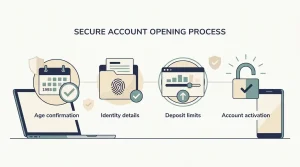
Before moving from browsing to real-money play, check that the casino is authorised to serve customers in Great Britain. Find its licence number and verify it on the UK Gambling Commission’s public register; a logo or claim on a website is not a substitute for checking the register. The operator should be the same business named there. If you cannot match the details, pause before entering payment information.
An operator must verify your age before allowing you to deposit. Online gambling is for adults aged 18 and over, but you should still expect to complete the site’s identity and age checks. Do not try to get around a failed or unfinished check by opening another account or using someone else’s details.
Best Online Casino Game Shows in the UK: How to Compare
Set a financial limit before you fund the account. Remote operators must prompt new customers to set one before their first deposit and make account-level limit controls accessible. Take time to find those controls and choose an amount you can afford to lose; a limit is useful only if it reflects your own circumstances. Check how to change or lower it, too, rather than assuming the setting will be easy to find later.
Self-exclusion should also be available through a UK-licensed casino. If you have decided that you need a break from gambling, use the tool rather than relying on willpower or simply switching games. You can also look for the operator’s internal complaints process and its access to an approved Alternative Dispute Resolution service. Those are practical details to know before a problem arises, not after.
Payment methods deserve a careful look. UK-licensed casinos cannot accept credit cards for gambling, including credit-card funds routed through a money service business. They also cannot accept wallet payments where the wallet allows credit-card funds to be used for gambling. If a payment route appears to bypass these restrictions, do not treat that as a helpful workaround.
Online Casinos With No Limits: What UK Claims Mean
Finally, online slot autoplay is banned in Britain. A site offering autoplay on an online slot is a reason to stop and check what you are using. Slot cycles must also be spaced so that at least two and a half seconds pass before the next one can begin. These safeguards do not make bonus-buy play risk-free, but checking the account controls and the way a site operates can help you avoid preventable problems before you deposit.
Slot Game Design: Reels, Paylines and Volatility
A slot’s layout gives you a first indication of how its ordinary play is organised. Many low-volatility slots use five reels and twenty-five or more paylines. Reels are the columns that spin; paylines are the patterns across them on which matching symbols can form a win. More paylines create more possible patterns to follow, but they do not by themselves tell you how large or frequent the returns will be.
Online casinos with NetEnt slots in the UK
Volatility describes the broad distribution of results. Low-volatility slots tend to return value through many smaller wins. High-volatility slots tend to pay less often, with larger amounts when wins occur. This is a design distinction, not a promise about any individual run: a low-volatility label does not mean every spin will produce a return.
The jackpot structure can also differ. Low-volatility games commonly use fixed jackpot amounts rather than progressive pools, where a prize can build over time. A fixed amount is part of the game’s stated design; it does not grow as players contribute to a shared pool. Alongside ordinary symbol combinations, these games may include bonus rounds that apply multipliers to wins accumulated during the feature.
These characteristics can help you understand what a game is built to do before considering whether it offers a buyable bonus. A bonus-buy option does not replace the underlying reel layout, paylines or volatility profile. The game still has its ordinary structure, with its own pattern of smaller or less frequent returns, whether the bonus is reached through play or accessed through that option.
Reel Count and Paylines
Define the layout and the patterns across the columns that can form a win.
Volatility
Describes the general distribution and rhythm of returns (low for frequent small wins, high for rarer large wins).
Jackpot Type
Determines if the top prize is a fixed amount or a progressive pool that builds over time.
Read the game information as a description of mechanics, not as a forecast. Reel count and paylines tell you about the layout; volatility indicates the general shape of returns; and the jackpot type explains whether the top prize is fixed or progressive. Taken together, these details make it easier to compare the design of bonus-buy slot games without assuming that a particular layout or feature guarantees a particular result.
How to Think About Slot Volatility and Your Playing Session
Volatility describes the rhythm of a slot’s results, not a promise about what will happen during your session. A low-volatility game tends to return smaller wins more often, while a high-volatility game may go longer without a winning combination and then deliver a larger one. Neither pattern tells you whether you will finish ahead.
Across most low-volatility titles, winning combinations appear on average every three to six spins. That is a broad pattern across games, not a schedule for an individual player. You could see several wins close together, or go longer without one. A winning combination may also return less than the stake, so counting winning spins alone does not show whether your balance is rising.
This distinction matters if you are comparing slots you can buy a bonus on. A bonus round can make results feel more eventful, but it does not make the surrounding session predictable. The pace of ordinary spins still varies, and a feature appearing does not guarantee that its result will offset earlier stakes. Treat volatility as a description of possible swings, not a way to identify when a win is due.
Over a short session, chance can produce a result that looks very different from a game’s longer-term pattern. Over enough play, however, a game with a positive house edge has an expected loss for the player. That remains true whether the losses arrive gradually or are interrupted by frequent small wins. A run of favourable results does not reverse that underlying expectation.
UK Online Casinos with Amatic Slots: What to Check
Before you start, decide how long you intend to play and what amount you are prepared to lose. Keep those decisions separate from the slot’s recent results: a sequence of wins is not evidence that another is imminent, and a quiet spell does not mean a payout is overdue. If the session stops feeling manageable, take a break rather than increasing your stake to recover losses.
Where to Find Slots with a Buyable Bonus Feature
A game’s title or thumbnail rarely tells you whether its bonus can be purchased. Check the slot’s information panel or help screen instead. Look for a clearly labelled bonus-buy option, feature purchase or similar wording, and read the accompanying rules to confirm what the option does. If the rules describe only a bonus triggered during ordinary play, that does not establish that you can buy access to it.
You can also inspect the game’s controls before starting a round. A purchase button or feature menu may appear beside the usual spin controls, but its presence and placement vary between games. Read the displayed cost and conditions before selecting anything; do not assume that a feature is available just because another slot from the same provider offers one.
Casino game libraries may let you filter or search by feature, but a category label is only a starting point. Open each game’s own rules and check for an explicit explanation of the purchase option. If the description is unclear, do not treat a general reference to bonus rounds as confirmation that the bonus is buyable.
There is no reliable basis for calling a particular title the best choice simply because it has this feature. The useful check is whether the game itself explains the option plainly and shows what you would be buying before you commit. If you cannot find that information in the rules or on-screen controls, move on rather than guessing.
Material created by the team LottoGo